
11 ways businesses can reduce carbon emissions
Shred Station is a certified carbon-neutral company. We’ve reduced and offset all of our internal emissions from formation to today, and these are our top tips for how you can reduce business emissions at your workplace.
As the world pursues net-zero, all businesses could be doing more to minimise their environmental impacts. With so many simple ways to reduce carbon emissions, there’s no reason not to operate in an environmentally friendly way.
If your business is getting started with emission reduction, there are 3 scopes to focus on.
Scope 1 – These are your direct emissions from owned or leased stationary sources and mobile sources. For example, your workspaces and your fleet.
Scope 2 – These are your emissions generated from the energy you purchase and use.
Scope 3 – These are your upstream and downstream supply chain emissions. This could be anything from the courier services you use to your business travel.
The quick wins for most organisations are likely to be in Scope 1 and 2. For Scope 3 reductions, you have to rely a lot more on things outside of your control, but reductions are possible by being selective with what suppliers you use.
The good news is that there are many steps businesses of all sizes can take to reduce carbon emissions. Here are 11 straightforward ways your business can reduce emissions and safeguard the environment.
1 – Recycling will help to reduce your downstream waste emissions
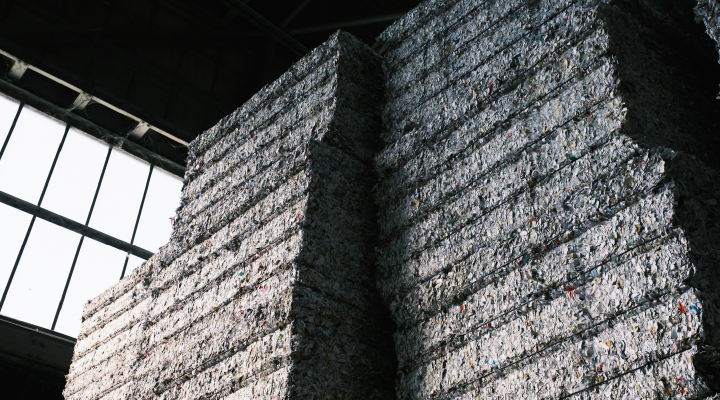
With the Simpler Recycling legislation now in place in England, and similar legislation in place across the rest of the UK, your company should already be recycling. Improving recycling rates at your workplace will therefore be one of the easiest ways to reduce your organisation’s carbon footprint. By recycling, you reduce the volume of raw materials needed to create products from scratch. For example, recycling a single tin can could save enough energy to power a computer for a full hour. Plus, tins are infinitely recyclable. A tonne of recycled paper could save 17 trees from deforestation, as well as 7,000 gallons of water, 380 gallons of oil, 4,000 kWh of energy, and 3 cubic yards of landfill space.
Improving recycling processes at your workplace could also nurture a greener work culture. This is likely to be attractive to your customer base, as well as your employees. A recent study found that 65% of people would be more likely to work for a company with a strong environmental policy. 64% also said that they’d possibly turn down a job offer from a company with a bad environmental record.
When it comes to paper recycling, something else to be mindful of is confidential paperwork. We both use and recommend to others a “Shred Everything” policy. This eliminates the risk of an employee making the wrong call regarding which documents to shred, minimising the chance of a data breach. If your business uses a professional shredding supplier, they should be recycling 100% of the paper they shred on your behalf.
2 – Buy recycled or refurbished materials wherever possible
Using recycled materials can help your business reduce upstream emissions of purchased goods, as well as aiding the conservation of the earth’s resources.
For example, using recycled paper products can help to reduce deforestation and preserve natural habitats. Insect populations are declining around the globe. These populations are being decimated by the destruction of habitats coupled with global warming. The UK’s butterfly population is in particular danger, with a fall of 50% in butterfly numbers since 1976. When insect populations decline, it affects the entire food chain. UK woodland bird populations are also down about 25% from 1970. Even hedgehogs are now listed as “vulnerable to extinction” on Britain’s red list of mammals, having fallen up to 30% in urban areas and 50% in rural areas since 2000.
By using recycled products, we can both safeguard the natural habitats of our nation’s wildlife and reduce our carbon footprint.
While recycled options can sometimes be slightly more expensive, the environmental cost of using brand-new products is much higher.
3 – Use sustainable suppliers to reduce Scope 3 emissions
Working with sustainable suppliers is a key way to reduce your company’s Scope 3 emissions. If you’re pulling out all the stops to minimise your environmental impacts, but work with suppliers who don’t protect the environment, you could be directly funding unsustainable practices.
A good certification to look out for when selecting suppliers is ISO 14001. This certification provides proof that an organisation has environmental management at the heart of its Quality Management System, and is actively improving resource efficiency and waste reduction. Be wary of suppliers that do not publish details around their environmental commitments, and try to use CarbonNeutral® certified suppliers wherever you can.
4 – Start making the transition to hybrid or electric company cars and fleet vehicles
If you operate a large fleet, making the transition to electric vehicles will mean a significant reduction in your Scope 1 emissions.
In the last few years, the EV market has come on in leaps and bounds. Ahead of the UK’s ban on new petrol and diesel cars coming into effect in 2030, now could be a good time to start thinking about investing in hybrid or electric vehicles for your company cars. Car manufacturers are making huge investments in developing their electric models, and electric cars are becoming more affordable. This brings the potential to own electric vehicles a more realistic possibility for businesses of all sizes. Of course, electric car leases are also available.
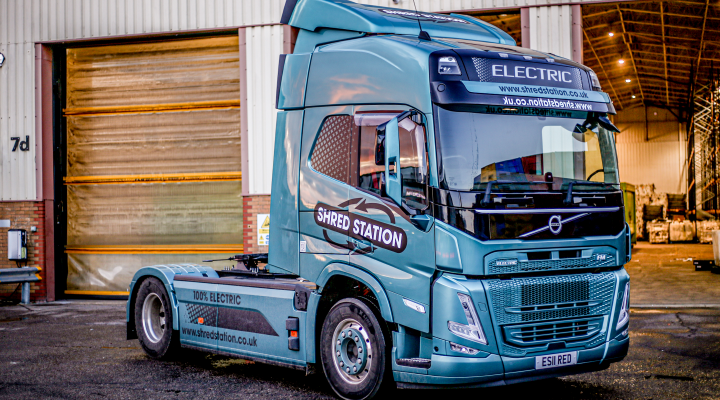
At Shred Station, we are proud to operate several electric trucks, electric forklifts, and hybrid or electric company cards. We also have car charging available at all of our depots, supporting our staff and visitors in their own journeys towards electrification.
5 – Switch to virtual meetings and events wherever possible
One of the lasting effects of the coronavirus pandemic is the switch from in-person meetings to virtual ones. Instead of travelling long distances for business meetings or corporate events, consider whether that meeting could be hosted online. This will save your staff commuting times and travel expenses, and will also reduce your company’s travel emissions.
Transport accounts for around one-fifth of global CO2 emissions. So, if everybody travelled a little less, there is certainly room for large reductions in collective CO2 emissions.
6 – For business trips, try to car share or use public transport
If your business trips or events must be held in person, using public transport is another way you can reduce your carbon emissions, particularly if the journeys to these trips or events will be single-passenger journeys.
The chart below from Our World in Data shows the average carbon footprint of travel per passenger per kilometre by transport medium.
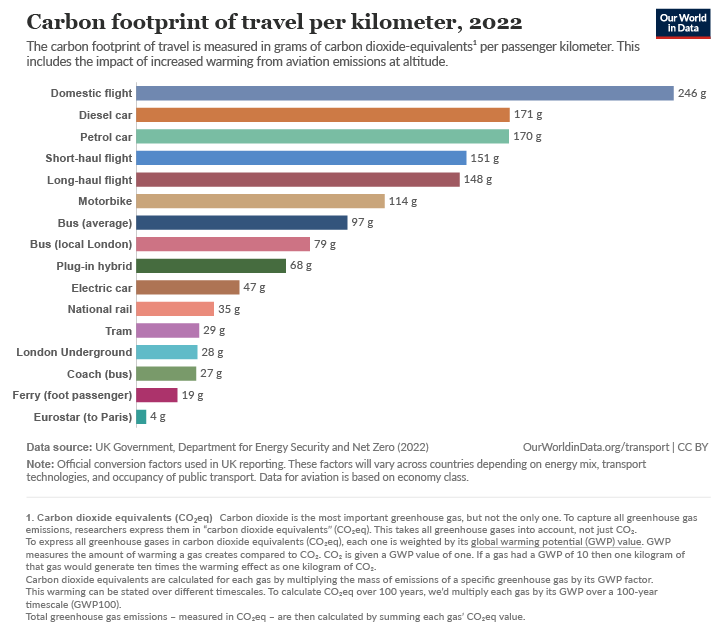
As you can see, a single passenger car journey in a petrol car has a carbon footprint of around 170g per km. This is 22g more than the average carbon emissions of a long-haul flight per passenger! It is much more environmentally friendly to use public transport such as buses or national rail services. Car sharing is also a great option, where possible. Having two passengers in a petrol car would mean fewer grams of carbon per passenger than bus travel.
7 – Invest in renewable energy, switch to green tariffs, and use energy-efficient office equipment
Investing in green energy and energy-efficient office equipment can be another great way to reduce your business’s carbon footprint through Scope 2 emissions.
The majority of energy suppliers now offer green or renewable tariffs. Or, you could even invest in your own renewable energy sources. Solar panels are a great option if your business has the cash reserves.
Our Shred Station head office is powered by solar, generating the energy we need to power our computers, phones, hand dryers and even our much-loved coffee machine. Using solar allows us to reduce our carbon emissions and means we don’t have to worry about rising energy costs.
When it comes to the physical workplace, here are a few easy ways to reduce your energy consumption:
- Use LED lighting and turn lights off once you leave the office. In the daytime, consider keeping lights off if there is enough natural daylight to work comfortably.
- Use kitchen appliances such as fridges or dishwashers that have a high energy rating.
- Enable energy-saving and battery-saving modes on all PC and mobile work devices.
- Reduce the office’s thermostat temperature. Keeping the thermostat down by just 1°c could reduce space heating energy by 13%!
- Encourage team members to dress appropriately for the season, or provide seasonal work uniforms. For instance, you could provide a thick jumper for the winter months and a lightweight polo for the summer months. This could save heating costs in the winter and air conditioning costs in the summer.
8 – Buy secondhand or refurbished office furniture
Buying used office furniture will not only save your company a bit of cash, but it’s also better for the planet. As already mentioned, reusing and recycling goods avoids contributing towards further depletion of natural resources like wood and metals.
Buying used office furniture doesn’t have to mean you end up with low-quality furnishings, either! Whenever offices close or have a refurb, most companies will sell their old equipment to a used office furniture company. Even high-end office furniture brands like Herman Miller and Haworth can end up in these second-hand shops at a fraction of their retail price – often cheaper than new, low-mid range office furniture would cost!
Buying sustainably sourced or recycled office furniture, such as recycled polypropylene canteen chairs and bamboo desks, is also a great way of reducing your carbon footprint.

9 – Encourage employees to reduce water usage
Water usage and treatment fall under your Scope 3 emission sources. By encouraging employees to use less water, you can save money and reduce your environmental impact. Whether it’s switching the dishwasher onto eco mode, or washing your fleet or company cars slightly less often, reducing water is an emission-saver that’s extremely easy to implement.
10 – Talk to your employees and customers!
Talking to your workforce about the environment and inviting them to offer their own suggestions on how your company can help combat climate change will encourage your workers to get on board with your environmental efforts. It can also help them to feel a sense of pride and purpose in reducing environmental impacts. Your employees will always be your best asset. Their ideas and involvement are essential for making sure the whole company succeeds with reducing emissions, recycling, and saving energy.
Your customers are also likely to respond well to your eco-policies and efforts to reduce your carbon footprint. Consumer preference trends indicate that people prefer to buy environmentally friendly products and services. They are even willing to pay a premium to do so.
At Shred Station, our CarbonNeutral® status and environmental commitments are big reasons our customers choose us over competitors. Not only can we operate in a way that satisfies our own ethos to cause minimal environmental damage, but we can also satisfy the wants of our customers at the same time. In short, operating in ways that reduce your business’s carbon footprint is a win-win-win situation for you, your customers, and the planet.
11 – Look into reputable carbon offsetting projects to neutralise the emissions your business does produce
While this is an emission neutralisation measure rather than a reduction measure, offsetting your carbon emissions is crucial for balancing your overall footprint. You can even become carbon-neutral by offsetting your total emissions to zero. The cost of this would vary based on your carbon outputs, but a carbon-neutral certification partner can help you find the most cost-effective option for your organisation. It’s vital to remember, however, that not all carbon credits are created equally. Invest in certified projects available on public carbon markets, and dig a little deeper to verify that the projects work to support the Sustainable Development Goals.
Carbon-neutral certification can also give your customers proof that you are committed to reducing your environmental impacts. The certification process often involves a greenhouse gas assessment detailing the emissions from your company’s usual operations. Assessments cover things like utility usage, miles driven in company vehicles, waste produced, and more. These will be verified by an independent party, who can then offer a range of projects to offset your emissions.
Offsetting carbon alone isn’t enough to make up for years of polluting with reckless abandon. You should also implement company-wide environmental policies and procedures to reduce emissions.