
What does the EU clothing destruction ban mean for your business?
If you’re a medium-large business that sells or distributes clothes in EU countries, the destruction of certain unsold apparel, accessories and footwear will soon be banned. For this reason, it’s more important than ever that you understand what’s happening when you entrust a company with your waste textiles.
The European Commission (EC) has outlined the new rules to stop the destruction of certain unsold clothing and shoes in the EU. The rules apply to commodity codes 4203, 61, 62, 6504, 6505, 6401, 6402, 6403, 6404, and 6405, as below:
- Apparel and clothing accessories made with leather/composition leather
- Apparel and clothing accessories that are knitted/crocheted
- Apparel and clothing accessories that are not knitted/crocheted
- Hats/headgear that are plaited or made by assembling strips of any material
- Hats/headgear that is knitted/crocheted, made of lace, felt, or other fabric
- Hairnets of any material
- Waterproof footwear made with rubber/plastic (where uppers aren’t fixed to the sole, assembled by stitching, riveting, nailing, screwing, plugging, or similar processes)
- Other footwear made with rubber/plastic (soles or uppers)
- Footwear with rubber/plastic/leather/composition leather outer soles, and leather uppers
- Footwear with rubber/plastic/leather/composition leather outer soles, and uppers of other textiles
- Other footwear.
See Annex VII – Consumer products of which the destruction by economic operators is prohibited.

There are clothing items where these rules will not apply.
What clothes aren’t affected by the EU clothing destruction ban?
EU sellers and distributors can still destroy clothes and footwear items that:
- Must be destroyed for health, hygiene and safety reasons
- Are damaged because of handling or after products have been returned, and they cannot be repaired cost-effectively
- Are unfit for the purpose for which they are intended, considering EU and national law
- Are offered for donation and aren’t acceptable
- Aren’t suitable for preparing for reuse or remanufacturing
- Aren’t suitable due to infringement of IP rights, including counterfeit products
- Or where destruction is the option with the least negative environmental impacts.
The new directive (item 56) – also states that:
“To disincentivise the destruction of unsold consumer products and to generate further data on the occurrence of this practice, this Regulation should introduce a transparency obligation for economic operators, with the exception of micro and small enterprises, requiring them to disclose information on the number and weight of unsold consumer products discarded per year at least on an easily accessible page of their website.”
This means a lot more transparency for sellers and distributors of clothing and footwear in Europe. But, without advancements in the ability to recycle textiles – particularly blended textiles – what should you do with unsold goods?
What are the alternatives to clothing destruction?
There are many options your business has before destruction needs to be considered.
Pre-empt waste before production begins
In Europe, an estimated 4-9% of unsold textiles are destroyed before ever being worn. Each year, this results in millions of tonnes of carbon emissions. If you’re running a medium-large business that sells or distributes clothes in the EU, you likely have internal records about losses related to unsold garments. While no one can know for certain which items will sell, being even slightly more conservative with orders can help to save money, reduce waste, and reduce carbon emissions.
Put items on sale, or sell them to off-price retailers
If putting items on sale is a viable option for your brand, this can help to prevent waste. You could also recoup some money that would otherwise be lost from items remaining unsold and their disposal costs. Alternatively, off-price retailers such as TK Maxx could be a workable solution to reduce volumes of unsold stock.
Consider donating unsold apparel and footwear
If there’s an option to donate your unsold apparel and footwear, this is a great way to enhance your CSR commitments. Donating unsold clothing can help low-income families with the rising cost of living and the societal pressure of wearing the latest trends – especially for children and teenagers. It can also benefit charities by providing high-quality garments that are likely to sell at reasonable prices, helping them to raise funds in a time when there is a rising cost associated with operating physical premises.
Explore the possibility of recycling
Textile recycling in the UK falls behind other recycling services in terms of availability, investment, and national infrastructure. For post-consumer textiles that aren’t suitable for re-use or re-wear, only a small fraction is recycled domestically. Most is sent to Energy from Waste or is exported as worn clothing, as shown below. For pre-consumer textiles that your business doesn’t want to resell or donate, your UK-based recycling options will be similarly limited.
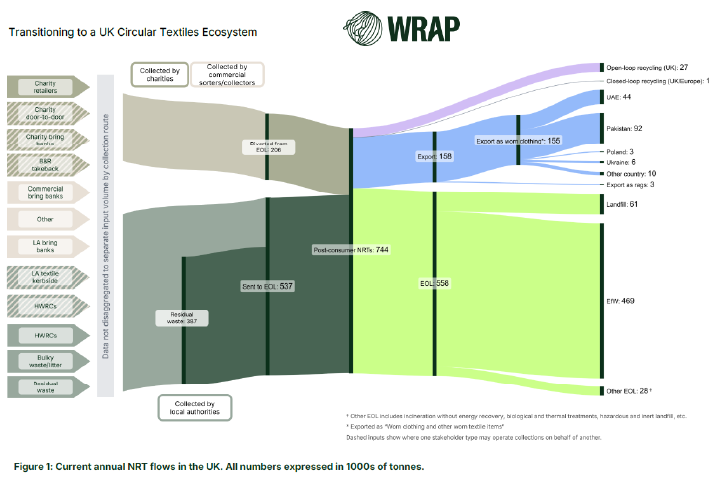
Source: WRAP: Transitioning to a UK Circular Textiles Ecosystem report.
What do we do at Shred Station?
At Shred Station, we handle all sorts of clothing. We regularly process uniforms that need to be destroyed to protect brands from employee impersonation, counterfeit clothes and accessories, unwearable clothing that has been returned to sellers, damaged clothing, clothing with manufacturing errors, and unsold stock. To us, it doesn’t really matter where the clothing has originated from. What matters for recycling is the fibres they are made from.
If your items arrive pre-segregated by fibre type with all hardware removed (e.g., zips), we will shred the garments to break them up and box the shredded materials for fibre-specific recycling. If your items arrive with different fibre types in the mix, there is little chance we will be able to recycle them into new garments. However, that doesn’t mean they can’t be reused or repurposed. We work with a number of partners to reuse blended, shredded textiles as filler material in items such as doorstops and footstools. Another option is rag recycling, where the fibres can be used in things like dust cloths and carpet underlay.
If, for any reason, you don’t want your unsold clothing to be reused in this way, or if we can’t recycle your items, we would use Energy from Waste. At Shred Station, nothing we shred goes to landfill.
What about clothes that are only sold in the UK?
If you’re only selling or distributing clothes in the UK, the new EU rules don’t apply to you. However, a blueprint for UK textiles extended producer responsibility was published in January 2026 by WRAP. There have also been government discussions around textile waste prevention programmes for several years. It’s only a matter of time before UK sellers will need to take more responsibility for clothing waste. Unfortunately, not all companies are transparent about what happens to any clothes you give to them to dispose of or recycle on your behalf.
As a proudly CarbonNeutral® certified company and environmentally conscious textile shredding and recycling supplier, we know what you need to look out for.
4 things to be aware of when outsourcing textile destruction or recycling
1. Always be mindful of greenwashing
Now that some shredding and destruction providers know that their services will still be suitable if their options are seen to have the least negative environmental impacts, greenwashing may increase. Remember, reputable companies that really do go above and beyond to reduce their environmental impacts will be able to evidence their efforts, and will be certified to high environmental standards.
2. If a company tells you your textiles are going to be “made” into sustainable concrete…
This almost certainly means your textiles are going to be incinerated. When you incinerate textiles – or pretty much any material – the remnants of the Energy from Waste incineration process is known as bottom ash. This ash can be used as an aggregate in concrete production. While the use of this byproduct does result in a lower carbon concrete, it requires huge volumes of materials to be incinerated to generate a usable ash. Your textiles will make up a fraction of that material, and most will be general waste. If a company tells you incineration isn’t a form of destruction, that’s simply untrue.
3. If a company tells you 100% of your clothing will be recycled into new garments…
This is also extremely unlikely to be true. Clothes recycling is a highly complex process, unlike something like paper recycling. This is because clothes are made from many different types of fibres. For instance, you could have 100% cottons, 100% polyesters, poly-cotton blends, wools, nylons, and countless other types of synthetic and non-synthetic fabrics. These fabrics are recycled in different ways, and some aren’t recyclable at all. You also have to consider things like buttons, zips, and embellishments like embroidery, printed designs, and things like sequins. To recycle these items in an economically viable way is incredibly difficult – unless you are working with single-fibre non-blended textiles that are separate from all other items.
4. Watch out for vague language
If a company says they will repurpose or remanufacture all your clothing items without any specifics, or if they use generic or non-committal language like “we aim to”, ask questions. Any reputable clothing waste processor will be happy to talk about the ins and outs of any innovative projects they are working on, partnerships they have, or any exciting developments in the textile recycling industry. At Shred Station, we would love to talk with you about our involvement with specialist recyclers, community projects, and our involvement with the Innovate UK-backed ACT UK project.
Here, we are transparent about textile recycling in the UK and its limitations, and what we do with your textiles. If we can’t recycle something, we won’t tell you that we can just to make a quick sale. Transparency and integrity are more important to us – and these are things we believe all business that processes confidential or brand-sensitive materials should prioritise. We will always work to find the most sustainable solution for your clothing and footwear waste. So, if you have requirements now or in the future, feel free to get in touch with our team to learn more.